


Costs and Timelines for Obtaining a WDA Licence
Introduction
One of the most common mistakes in WDA planning is assuming that cost is mainly about the application fee and that timing is mainly about how fast a form can be submitted. Both assumptions are wrong. In reality, the true cost of obtaining a WDA licence includes regulatory fees, inspection implications, premises readiness, documentation development, responsible person arrangements, staff preparation, and the financial consequences of delay. The true timeline includes not just submission and review, but the time required to build an operation that can survive regulatory scrutiny.
That distinction matters because leadership teams often plan around the visible part of the process and ignore the hidden part. They budget for forms, perhaps for consultancy, and maybe for a site. But they do not always budget for corrective actions, validation work, procedural refinement, or the time needed to close quality gaps before inspection. The result is a planning model that looks sensible on paper and becomes expensive in practice.
For directors, founders, and operational leads, the right question is not simply “What does a WDA licence cost?” It is “What does it cost to get authorised without creating avoidable delay, rework, or regulatory weakness?” That is a much better commercial question, because it reflects how licensing actually works.
The Published MHRA Fees Are Only the Starting Point
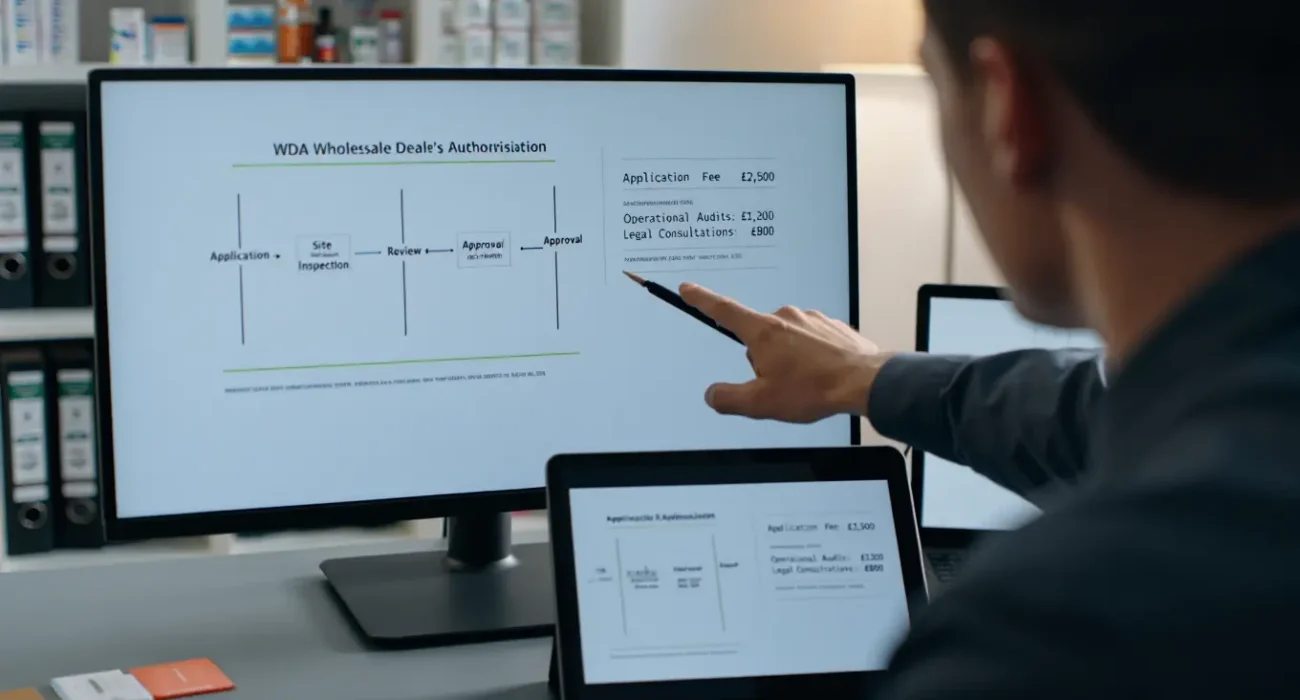
The official MHRA fees page gives a current baseline for wholesale distribution authorisations. It lists a standard new application plus full inspection fee of £6,295, made up of a £2,159 application fee and a £4,136 inspection fee. It also lists an additional inspection fee per extra site if required, reduced-rate options in specific limited circumstances, variation fees, and standard inspection fees for ongoing regulatory activity.
Those figures are important because they provide the formal regulatory baseline. They also confirm that the MHRA does not treat licensing as a paperwork-only process. Inspection is priced into the application because inspection is central to how the authorisation decision is made.
However, businesses that budget only for the official fee schedule almost always underestimate the real cost of preparation. The regulatory fee is just the visible entry point. The more consequential costs usually sit inside readiness.
What the Real Cost Usually Includes
The practical cost of obtaining a WDA licence is shaped by how prepared the business is before submission. If a company already has suitable premises, compliant storage arrangements, strong quality documentation, and experienced oversight, the cost profile may be relatively controlled. If not, the spend can widen quickly.
Typical real-world cost drivers include premises adaptation, storage and security controls, temperature monitoring systems, validation work, documentation drafting, quality management system development, training records, supplier and customer qualification frameworks, and Responsible Person support. Some businesses also need stronger inventory processes, more formal deviation and CAPA systems, or external help to make the operating model inspection-ready.
None of those items are discretionary in any serious sense. They may not all appear as separate regulatory line items, but they influence whether the business can pass through the licensing process efficiently or whether it enters a loop of correction and delay.
This is why many senior teams are surprised by the final number. The application fee may look manageable, but the operational standard required to justify approval is what drives the wider spend.
Timelines Are Driven by Readiness, Not Just Submission
GOV.UK guidance on applying for manufacturer or wholesaler licences states that applications should normally take 90 working days to process. That is an important benchmark, but it is not a guarantee of business-ready timing.
The phrase “normally take” matters. It reflects the regulatory process once an application is underway, not the total elapsed time from initial decision to live authorisation. A business still needs to prepare the application properly, ensure the site is ready, assemble supporting systems, and be capable of responding coherently during inspection. If readiness is weak at the point of submission, the nominal 90-working-day expectation may have limited practical value.
The better way to think about timing is in phases. First comes internal preparation. Then comes submission and MHRA review. Then inspection and follow-up. Then final approval if the licensing authority is satisfied. Each phase can expand or contract depending on how complete the underlying operation is.
Why the Cheapest Route Often Becomes the Most Expensive
There is a persistent temptation in licensing projects to minimise early spend. On the surface, that feels commercially sensible. Businesses want to avoid overcommitting before authorisation is granted. But in practice, underinvestment in readiness often creates the most expensive version of the process.
Weak documentation leads to rework. Unclear responsibilities create inspection concern. Poorly configured storage and quality controls delay approval. Founders lose time managing avoidable issues. Commercial launch dates move. Suppliers wait. Internal confidence falls. In some cases, the business ends up paying twice, once for the hurried initial attempt and again for the corrective work needed afterwards.
The issue is not that businesses should overspend. It is that they should distinguish between productive preparation and false economy. Spending intelligently on readiness is not the same as spending excessively. In licensing, the latter creates waste, but the former usually protects timeline and outcome.
How Site Complexity Changes Both Cost and Timing
The more complex the distribution model, the more licensing tends to require. A single-site, tightly scoped operation is rarely as costly or as complicated as a multi-site or multi-function model. The current MHRA fee schedule itself reflects that additional sites can trigger extra inspection fees.
But the real impact goes beyond the fee structure. More sites mean more storage conditions, more records, more local procedures, more training needs, and more inspection exposure. Even where the business sees those sites as commercially necessary, leadership should understand that complexity carries a regulatory price.
The same is true of activity type. Businesses handling more challenging product profiles, more demanding supply routes, or more complex sourcing and onward-supply arrangements may need stronger systems than those operating within a narrow, lower-risk scope. That is not a reason to avoid growth. It is a reason to scope growth carefully.
The Cost of Delay Is Often Larger Than the Cost of the Application
When businesses talk about licensing cost, they often focus on what they must pay the regulator. In many cases, the more important number is the opportunity cost of delay.
A three-month or six-month delay can affect launch timing, distribution contracts, warehouse efficiency, and leadership focus. It can also weaken internal momentum. Teams that expected to move into trading activity may find themselves stuck in document repair, corrective actions, or further preparation. The business is spending money, but revenue is not moving at the same pace.
This is where licensing decisions become strategic. If the board or leadership team understands that time-to-authorisation affects commercial timing, then readiness work stops being an inconvenience and becomes part of market-entry planning.
What Businesses Should Budget For Mentally
A strong budgeting mindset for WDA licensing includes three levels of cost.
The first is fixed regulatory cost, meaning published fees and related application charges.
The second is readiness cost, meaning what the business must build or improve to meet expected standards credibly.
The third is timeline risk, meaning the cost of getting the first two levels wrong.
That third category is often omitted in planning discussions because it does not sit neatly in a spreadsheet cell. But it is usually the category with the greatest strategic effect. Delayed authorisation can change revenue timing more dramatically than the formal fee itself.
For businesses that want to avoid this, WDA licence application support should be viewed as part of risk reduction and planning discipline, not merely as a convenience.
How to Think About a Realistic Timeline
A realistic licensing timeline should start before submission. Businesses need enough time to define scope, confirm premises suitability, build or refine their GDP system, appoint and properly position the Responsible Person, and ensure that day-to-day practice matches the written system.
Only then does the formal clock really become useful. Once submitted, the 90-working-day benchmark gives a planning reference point, but not a guarantee. Inspection readiness, responsiveness, and clarity of the application still matter significantly. GOV.UK licensing guidance and MHRA inspection guidance both make clear that the process is tied to regulatory scrutiny, not just form completion.
A realistic operator plans for authorisation with margin, not with optimism. That does not mean assuming failure. It means understanding that regulated timelines behave differently from purely commercial ones.
Conclusion
The cost and timeline of obtaining a WDA licence are best understood as an operational project, not just a regulatory transaction. The published MHRA fees matter, but they are only the visible part of the process. The real determinants of cost and speed are readiness, scope, quality system maturity, and the ability of the business to withstand inspection without avoidable weakness.
Businesses that treat licensing as a strategic build phase usually spend more intelligently and move more smoothly. Businesses that treat it as a narrow administrative task often discover the real complexity too late.
For leadership teams, the goal should not be to pursue the cheapest-looking route. It should be to pursue the most controllable route, the one that balances cost, credibility, and timeline in a way that supports commercial growth rather than disrupting it. If you want help planning that properly, you can contact us.