


Freezer Temperature Mapping for Pharmaceutical Storage: What a GDP Study Should Cover
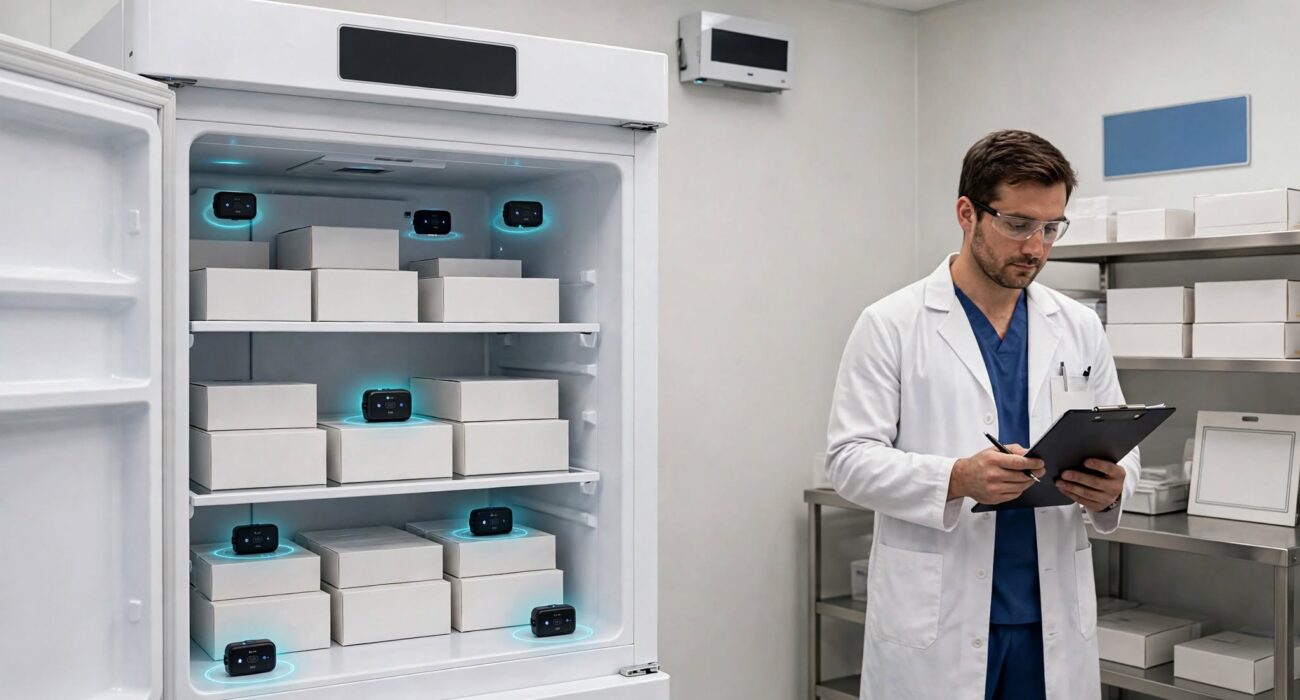
If you hold frozen medicines, vaccines or clinical supplies, you need evidence that every shelf and corner of each freezer stays within the product’s storage range. Freezer temperature mapping provides that evidence. A freezer does not behave like a fridge or a cold room, so a study copied from a cold room protocol can miss the spots where product is most at risk.
This guide covers what the study should include for chest, upright, walk-in and ultra-low freezers, and what the report should show. The MHRA expects the Responsible Person to be part of the whole mapping process.
Key Takeaways
- A freezer that stores medicines needs initial temperature mapping before use, under representative conditions, like any other GDP storage area.
- Map each freezer twice: at its lowest stock, where frozen stock gives least protection (SPS), and fully loaded with a representative load, which the MHRA expects.
- A steady-state run is not enough on its own. Add door-opening, defrost, power-failure and alarm tests, chosen by risk.
- The report should show where the permanent monitoring probe goes and which parts of the unit must not hold product.
- Repeat the mapping to take account of seasonal variations, after a move, a repair or a change of settings or use, and when monitoring data show drift.
What freezer temperature mapping is and why freezers need their own study
Freezer temperature mapping is a study of temperatures across the storage space of a freezer, recorded by calibrated loggers over a set period, under the conditions the unit meets in use. It shows the warmest and coldest points and whether the whole usable space stays within range. It is not the same as freezer temperature monitoring, which records fixed points continuously. Mapping tells you where those fixed monitoring points should go, as GDP section 3.2.1 requires. For the principles that apply to any storage area, see what temperature mapping is.
Freezers need their own study because the features that make them work, such as defrost cycles, powerful compressors and a door that opens onto a very cold space, also cause their largest temperature movements. A plan written for a warehouse or a 2 to 8 °C cold room usually does not test for these.
What UK GDP guidelines expect for frozen storage areas
There are no separate freezer temperature mapping guidelines in GDP. A freezer that stores medicines is a storage area, and the same requirements apply.
Section 3.2.1 of the EU Guidelines on Good Distribution Practice (2013/C 343/01), which the MHRA lists among its GDP guidance, asks for:
- an initial temperature mapping exercise before use, under representative conditions
- monitoring devices placed according to the results, where the extremes of fluctuation occur
- repeat mapping according to a risk assessment, or after significant changes to the facility or the temperature-controlling equipment
The MHRA Inspectorate covered these points in Temperature mapping – an introduction (July 2016). It adds that the mapping should be repeated to take account of seasonal variations, and that the guidelines say mapping should take place but not how. The licence holder chooses the method. The wider background is in regulatory requirements for temperature mapping in the UK and EU.
The acceptable range is the storage condition stated for each product, not the freezer’s setpoint.
How freezers behave differently from fridges and cold rooms
Defrost cycles. Many freezers warm the evaporator at intervals to clear ice, which can briefly raise the air temperature near the coil. The study should capture several cycles and record when each happens.
Frost and ice build-up. Ice on coils, walls and door seals changes the airflow over weeks. A unit mapped just after a manual defrost can perform differently three months later.
Compressor cycling. The compressor’s on and off pattern shows as a regular saw-tooth in the data. The analysis has to tell it apart from a fault.
Door openings. Cold air falls out of an open upright freezer and warm, moist air enters, adding frost to the seal. In a picking operation, doors may open many times an hour.
Frozen stock acts as ballast. A full freezer holds its temperature better than an empty one. The NHS Specialist Pharmacy Service advises mapping freezers “with their lowest stock holding or empty if possible” for this reason (SPS, Mapping the temperature of medicines storage areas, November 2022). The MHRA blog adds that an area mapped empty should be mapped again when fully stocked, and a comment on the MHRA blog says empty boxes are not an appropriate simulated load for small fridges and freezers. A freezer therefore needs both runs, as in the Inglasia guide to cold room and fridge temperature mapping.
Planning the study: which freezers, which conditions, empty or loaded
List every freezer that holds or may hold medicines, including back-up units. For each, record its type, volume, location, contents and the product’s storage range. Then set the conditions for each run.
- Empty or minimum load. With little frozen stock to steady it, the unit has the least thermal ballast (SPS). If it cannot be emptied, use the lowest stock level it normally runs at and record what was inside.
- Fully loaded. A run with a representative load, using dummy product rather than empty boxes, with doors opened at the usual rate.
- Room conditions. A freezer rejects heat into the room. A unit in an unheated loading bay in winter or a hot plant room in summer behaves differently from one in an air-conditioned store. Record room temperature, and consider seasonal runs where the room is not controlled.
- Duration. SPS states that the minimum length of mapping is usually 48 hours, and longer may be needed to represent use (SPS). A comment on the MHRA blog says the company must decide and be able to justify the length. For a freezer, cover several defrost cycles and at least one full working day of door use.
Write this into a protocol with acceptance criteria before the loggers go in. Where the freezer is also qualified as equipment, the mapping usually supports its performance qualification, so align the protocol with the freezer’s qualification (validation) plan rather than running two separate studies.
How many loggers a freezer needs, and where to place them
Loggers should cover the full volume where product can sit, plus the points most likely to run warm or cold. No GDP text sets a number. For a full-size upright freezer, the SPS fridge and freezer layout comes to nine loggers: four corners of the top shelf, four of the bottom shelf and one in the middle of the middle shelf (SPS). Larger units and walk-ins need more.
| Freezer type | Core positions | Add loggers at |
|---|---|---|
| Upright | Each corner of the top and bottom shelves, and the middle of the middle shelf (SPS) | Door seal, evaporator or fan outlet, extra mid-points in double-door units |
| Chest | Corners and centre of the top and bottom of the storage space | Lid seal, inside baskets where product sits |
| Walk-in | A grid across the racking at low, middle and high levels | Door, strip curtain, near the evaporator, product close to walls |
In a chest freezer, watch the top layer near the lid, which warm air reaches first when the lid opens. In every unit, keep probes off walls and coils, record each position on a drawing or photograph, and add one logger outside the unit for room temperature.
Tests to include beyond the steady-state run
A steady-state run shows how the freezer behaves when nobody touches it. Choose further tests by risk and record them in the protocol.
- Door opening. Open the door for a set time that reflects real use, then record how far the warmest logger rises and how long it takes to recover.
- Defrost. Mark each defrost in the data, and show whether any position leaves range.
- Power failure. Run this test empty or with dummy product, never with stock for sale. The MHRA blog notes that dummy products avoid compromising genuine product. Switch off the supply and record how long the unit stays in range. That tells you how long you have to act on an alarm.
- Alarm check. GDP section 3.3 says alarm levels should be set appropriately and alarms regularly tested. Confirm the alarm reaches someone who can act out of hours.
Acceptance limits for these tests, such as a recovery time, should come from your own risk assessment and product data. No single regulatory figure was found for them.
Deep freezer and ultra-low temperature (ULT) mapping: what changes
Deep freezers and ULT units follow the same principles as other freezers, but three things change.
The equipment. Standard loggers are often not rated for ultra-low temperatures. Use loggers or probes rated and calibrated across the range they will see, with calibration points near the working temperature. See loggers and reference equipment for mapping.
Getting the probes in. Cables through a door seal can create a leak that changes the result. Use the unit’s access port, or loggers that sit fully inside and are read afterwards.
The consequences of a failure. A ULT unit can leave range quickly once power or cooling fails, so the power-failure test and the alarm route carry more weight.
What the freezer mapping report should show
The report is the record an inspector will read, and the RP, who should be part of the whole mapping process, should review it before the freezer is used for medicines. It should include:
- the protocol reference and acceptance criteria set before the study
- the unit’s identity, location, model, setpoint and the product range it serves
- the loading state for each run and what was inside
- logger serial numbers, calibration certificates traceable to a recognised standard (GDP section 3.3), and positions on a drawing
- start and end times, logging interval and room temperature
- graphs for every logger, with defrosts, door openings and tests marked
- minimum, maximum and mean for each position
- every excursion, with its investigation and conclusion
- the recommended position for the permanent monitoring probe
- any area of the unit where product must not be stored
- a signed and dated conclusion against the acceptance criteria
When to repeat temperature mapping of freezers
Repeat the mapping when a risk assessment says so, after any significant change, and to take account of seasonal variations (MHRA). For a freezer, that includes moving the unit or changing its room, a repair to the compressor, evaporator, controller or door seal, a change of setpoint or defrost settings, a change of use, and monitoring data that show drift or repeated alarms.
Many sites also set a routine interval based on their own risk assessment rather than a fixed regulatory interval. See how often to repeat temperature mapping.
A checklist for a freezer mapping study
A freezer study an inspector can follow answers four questions:
- Was the unit mapped at minimum stock and again fully loaded?
- Did the study capture defrosts, door openings and a power failure?
- Are logger positions and calibration traceable?
- Does the report state where the monitoring probe goes and where product must not sit?
Inglasia’s temperature mapping service covers cold rooms and freezers, from study design to the final mapping report. If you need a freezer mapping study planned, carried out or reviewed, contact us to discuss how we can help.