


Cold Room Validation: Where Temperature Mapping Fits in IQ, OQ and PQ
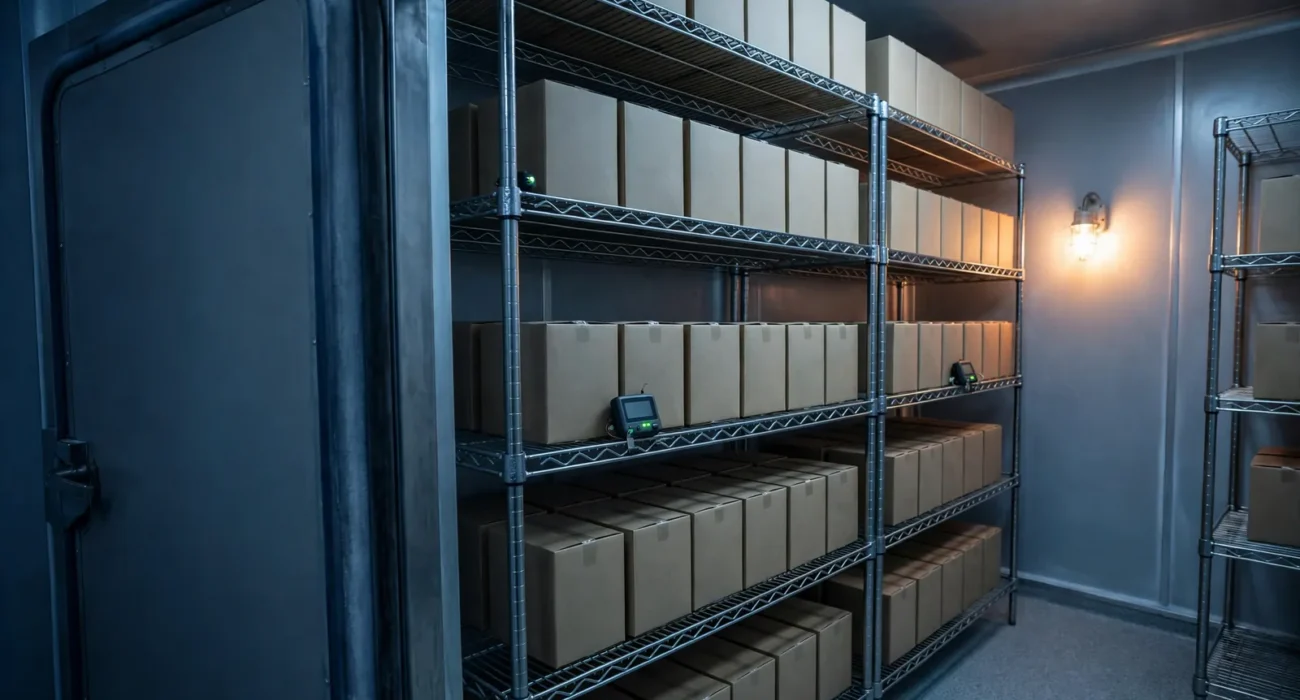
A new cold room, or one that has had a significant change, should not hold medicines until it has been qualified. Cold room validation is the documented evidence that the room is built as specified, works as designed when empty, and keeps product within its range once loaded and in daily use. Temperature mapping provides part of that evidence.
This guide sets out the stages of cold room qualification for a 2 to 8 °C store, which mapping and challenge tests belong in each stage, and the records an inspector may ask to see.
Key Takeaways
- Wholesale distributors should qualify key storage equipment before use and after significant changes, with the scope set by a documented risk assessment (EU GDP Guidelines, section 3.3.2).
- EU GMP Annex 15 gives the usual stage structure: user requirements, design qualification (DQ), installation qualification (IQ), operational qualification (OQ) and performance qualification (PQ).
- The empty-room mapping belongs in OQ, and the loaded mapping in PQ. Door-opening recovery is checked in both (WHO Technical Supplement 7).
- Neither GDP nor Annex 15 fixes a requalification interval. The interval should be set by risk assessment and justified.
| Stage | Main tests for a cold room | Records it produces |
|---|---|---|
| URS and DQ | Design checked against the user requirements | URS, risk assessment, DQ report |
| IQ | Installation, services and calibration checked against drawings | IQ protocol and report, calibration certificates, manuals |
| OQ (empty) | Alarms, empty mapping, door-opening recovery, power failure | OQ protocol and report, mapping data, alarm test sheets |
| PQ (loaded) | Loaded mapping, door-opening recovery | PQ protocol and report, release for routine use |
What cold room validation involves
In strict terms, the cold room is qualified and the storage process that uses it is validated. WHO Technical Supplement 7 puts it this way: “qualification is part of validation, but the individual qualification steps do not in themselves constitute process validation”.
WHO lists what qualification must show before a store is released for routine use:
- The installation, including control, monitoring and alarm systems, matches the drawings and specifications.
- Air temperatures throughout the storage zones stay within limits, both empty and in the normal loaded condition.
- Zones that must not be used for product are identified, for example near cooling coils or cold air streams.
- How long the room holds its range after a power failure, and how long it takes to recover once power returns.
- How long the room takes to return within limits after a representative door opening.
Items 2 to 5 are shown by mapping and challenge tests, so temperature mapping validation forms part of cold room validation. For the mapping study itself, see what temperature mapping is.
The rules that apply in the UK
A UK wholesaler works to Good Distribution Practice (GDP). Section 3.2.1 of the EU GDP Guidelines says an initial mapping exercise should be carried out “on the storage area before use, under representative conditions”. Section 3.3.2 adds that distributors “should identify what key equipment qualification and/or key process validation is necessary”, set the scope with a documented risk assessment, and qualify equipment “before commencing use and after any significant changes, e.g. repair or maintenance”.
The GDP Guidelines do not describe how qualification should be carried out. Two guidance documents can be used for this:
- EU GMP Annex 15, Qualification and Validation, in operation since 1 October 2015. It is written for manufacturers, and wholesalers are not bound by it, but its stages are widely used to structure equipment qualification.
- WHO Technical Supplement 7, Qualification of temperature-controlled storage areas (May 2015). It applies the stages to cold rooms and other fixed stores, and is written for wholesalers, distributors and third-party logistics providers (3PLs). It is guidance and is not part of UK law.
The MHRA’s GMP and GDP guidance page links to both EU texts. As the page does not say how they apply in Great Britain and in Northern Ireland, sites should confirm which edition they work to. For more, see the UK and EU rules on temperature mapping.
Before testing: requirements, risk assessment and the validation plan
Annex 15 starts with a user requirements specification (URS): a document that states what the room must do and should be “a point of reference throughout the validation life cycle”. Design qualification then checks the design against it. For a cold room, the URS should cover at least the temperature range, the storage volume and racking layout, door traffic and loading routines, the monitoring and alarm system, and the response to a power failure.
A risk assessment of the room and its use should then set the scope of testing, as GDP 3.3.2 and Annex 15 both expect. The validation plan should set the order of the stages, who approves each document and how test results are traced back to the URS. Where a third party writes the cold room qualification protocol, Annex 15 says the site should “confirm suitability and compliance with internal procedures before approval”.
Installation qualification: is the cold room built as specified?
IQ checks the room and its equipment against the drawings and specifications. Annex 15 lists correct installation of components and instruments, calibration, the supplier’s operating and maintenance instructions, and materials of construction. For a cold room, that means checking the panels, door seals, refrigeration units, evaporators and controller against the specification, inspecting the electrical and mechanical services, confirming the calibration certificates of controllers and probes, and filing the manuals and maintenance requirements.
Temperature mapping is not part of IQ. WHO says IQ “must be completed before any further functional or operational tests are carried out”.
Operational qualification: the empty-room mapping and challenge tests
OQ shows the room works as designed across its operating range. Annex 15 asks for tests of “upper and lower operating limits, and/or ‘worst case’ conditions”. WHO says OQ is run with the room empty and lists these tests:
- Procedures and calibration: check the standard operating procedures (SOPs) and the calibration certificates of controllers and sensors.
- Alarms: run at least one high and one low temperature alarm test, plus the door alarm if fitted, and confirm every alert route works, such as the sounder, SMS or remote monitoring.
- Empty mapping: monitor the whole room with calibrated data loggers for at least 24 hours.
- Door opening: check that temperature recovers after a door opening.
- Power failure: record the holdover time (how long the room stays in range with the power off) and the time to recover once power returns. WHO notes that for cold rooms “there are usually no set acceptance criteria” for this test, and the results are useful for emergency planning.
Neither GDP nor Annex 15 sets a study length, so the protocol should justify the length chosen. WHO gives 24 hours as the minimum for the empty study.
The empty mapping shows the warm and cold spots that come from the room itself, such as near the evaporator or door. For logger placement, see our best practices for cold room temperature mapping. Annex 15 says a successful OQ “should allow the finalisation” of operating procedures, training and preventive maintenance.
Performance qualification: the loaded mapping and door-opening recovery
PQ shows the room performs in routine use. WHO says PQ is run with the room “loaded and having been allowed to reach stabilized conditions”, and lists two tests:
- Loaded mapping: repeat the OQ mapping with the room loaded normally, using the same logger arrangement, so the two studies can be compared.
- Door-opening recovery: open the door for as long as it is opened in routine work; with several doors, test the sequence and simultaneous opening too. WHO gives an example criterion: every logger back within 2 to 8 °C within 30 minutes of the doors closing. The protocol should set the site’s own limit.
The MHRA Inspectorate blog says an area mapped empty should be mapped again when fully stocked, and that mapping should be repeated for seasonal variation. The PQ, or a follow-up study, should cover both summer and winter.
The empty and loaded results should be used together to set the permanent monitoring probe positions, as GDP 3.2.1 says that monitoring equipment should be located according to the results of the mapping exercise. If the loaded study shows a different warm or cold spot, the reason for each probe position should be recorded. For larger stores, see our step-by-step guide to mapping a warehouse, and for freezers, our guide to freezer temperature mapping.
Acceptance criteria, deviations and the qualification report
Each stage needs a protocol approved before testing. Annex 15 says protocols should define “the critical systems, attributes and parameters and the associated acceptance criteria”, and allows IQ and OQ documents to be combined. Typical cold room criteria are that every logger stays within range for the whole study, each alarm activates at its set point and reaches every alert route, and all loggers recover within the set time after the door-opening test.
A result that fails a criterion should be recorded as a deviation and investigated. Annex 15 says significant changes to the approved protocol during testing, such as to acceptance criteria, should be documented as a deviation and scientifically justified.
The report summarises results against each criterion and lists deviations, actions and owners. Annex 15 asks for a formal release to the next stage, with conditional approval only where a documented assessment shows no significant impact. At the end of PQ, WHO states that the store “cannot be formally released for routine use” until all PQ deviations are corrected.
At a wholesaler, the Responsible Person (RP) should be involved in the mapping and aware of its findings. The MHRA blog says “the RP should be party to the whole mapping process”. In WHO’s model, in-house protocols and reports are authorised by the responsible managers and quality assurance (QA). See the Responsible Person’s role for the RP’s wider duties.
When a cold room should be requalified
GDP 3.2.1 asks for mapping to be repeated according to a risk assessment or “whenever significant modifications are made to the facility or the temperature controlling equipment”. Typical triggers are:
- a new refrigeration unit, evaporator or controller;
- a change to the racking layout or storage zones;
- repeated alarms or excursions;
- higher stock levels or more door traffic than the room was qualified for.
Without a change, Annex 15 asks for evaluation “at an appropriate frequency”, with the period justified. Neither GDP nor Annex 15 gives a number of years, so the interval should be set in the risk assessment and reviewed against the monitoring data. See how often to repeat temperature mapping.
Documents to have ready for an inspector
For cold storage validation, the following records should be available for an inspection:
- the URS, risk assessment and validation plan;
- the approved IQ, OQ and PQ protocols, with acceptance criteria;
- calibration certificates for the data loggers and the room’s own probes;
- the raw mapping data, empty and loaded kept separate, with logger position plans;
- alarm, door-opening and power-failure test records;
- deviation records and their corrective actions;
- the signed reports and the formal release for use;
- the reasons for the permanent probe positions and the requalification interval.
Cold room validation uses the same staged and documented approach as the process validation lifecycle.
Inglasia’s temperature mapping service covers mapping studies from study design and logger placement to the final report, with mapping data that can support your OQ and PQ. If you need support planning the mapping for a new or modified cold room, contact us to discuss how we can help.